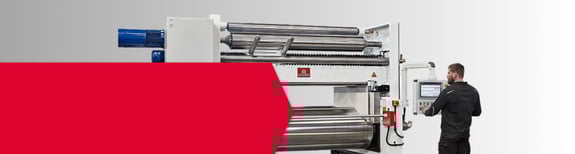
Stock Blender – Automated Mixing on the Mixing Mill
The stock blender is a proven device for mixing mills that automates to a certain extend and standardizes the rubber compounding process. Anyone looking for a reliable solution that delivers consistent, reproducible mixing quality on the mixing mill will find the stock blender indispensable.
What Is a Stock Blender?
In a mixing mill, the compounding process is typically discontinuous. The quality of the finished compound depends heavily on the operator's experience and attention to detail. To standardize this process and reduce reliance on manual intervention, engineers sought automated solutions early on.
The result: a device now widely known as the "stock blender", a term established in both English-speaking countries and the broader rubber processing industry.
Design and Functionality of the Stock Blender
The stock blender essentially consists of two rolls that match the width of the mixing mill rolls but are significantly smaller in diameter. These rolls are arranged vertically and slightly offset above the work roll:
- The bottom roll (blender roll) is driven by a continuously variable drive.
- The top roll functions as a pressure roller.
- On the working side, a pair of material guide rolls (also known as the wig-wag) are mounted horizontally and can be traversed laterally in both directions via a separate drive system.
Mixing Cycle with the Stock Blender
Once a cohesive, stable rubber sheet has formed on the work roll after all materials have been added, the automated process begins:
- The operator cuts the rubber sheet and transfers it between the guide rolls over the driven blender roll.
- The pressure roller: raised in the resting position is reapplied. On modern stock blenders, this is done pneumatically.
- The rubber sheet is peeled off the work roll and guided over the blender roll, which re-feeds it into the nip of the mixing mill from the rear.
- The wig-wag drive is engaged: the oscillating movement of the guide rolls across the full width of the work roll continuously deforms and homogenizes the rubber sheet without further operator intervention.
- After the set mixing time or a defined number of passes, the sheet is cut from the blender and removed from the work roll as slabs or billets.
Key Advantages of the Stock Blender
Using a stock blender on a mixing mill offers significant advantages over purely manual compounding:
- Fast and intensive mixing for superior batch homogeneity
- Effective cooling of the rubber compound through continuous material flow
- Higher batch capacity: the mixing mill can process a larger volume of rubber compound
- Reproducible compound quality independent of the individual operator
- Reduced manual effort and lower error rate throughout the mixing process